Case Study Pages That Close the Deal Before the Estimate Call: Structuring Past-Project Proof for Builders and Remodelers
A homeowner finds your website at 9pm, three days before they're ready to call anyone. They don't read your "About Us" page. They don't care that you're "family owned since 1998." They click straight to your project photos, and in about 40 seconds they decide whether you're the kind of contractor who can handle their job — before your phone ever rings.
That's the job of a case study page. Not a stock-photo gallery. Not a slideshow of finished kitchens with no context. A real, structured page that proves you've solved this exact problem before, for a homeowner who looks a lot like them.
Most contractor and remodeler sites skip this entirely, or bury it as a generic "Our Work" tab with twelve photos and zero text. That's leaving the easiest conversion lever on the table. Here's how to build it right.
A Photo Gallery Isn't a Case Study
A gallery shows what you built. A case study shows what you solved. The difference is the words around the pictures.
If all a homeowner sees is a pretty kitchen with no caption, they assume it cost $150,000 and took eight months — and they click away before they find out otherwise. A case study removes that guesswork. It tells them the starting problem, what you actually did, what it cost, how long it took, and what the homeowner said afterward. That's the proof that gets someone to fill out a form instead of bouncing to your competitor's site.
The Five Things Every Case Study Page Needs
Keep the structure the same every time so homeowners can scan it fast:
- The starting problem. One or two sentences, in plain language. "The kitchen had one working outlet and a layout from 1987" tells a homeowner more than any adjective could.
- The scope, in writing. What was actually done — cabinets, counters, electrical, layout change. Not "full remodel." List it.
- The number. A real budget range and a real timeline. "$38,000–$44,000, completed in 9 weeks" does more selling than ten "beautiful" or "stunning" adjectives combined. Homeowners self-select based on the number — the ones who can't afford you filter themselves out before the call, and the ones who can feel like they already know what to expect.
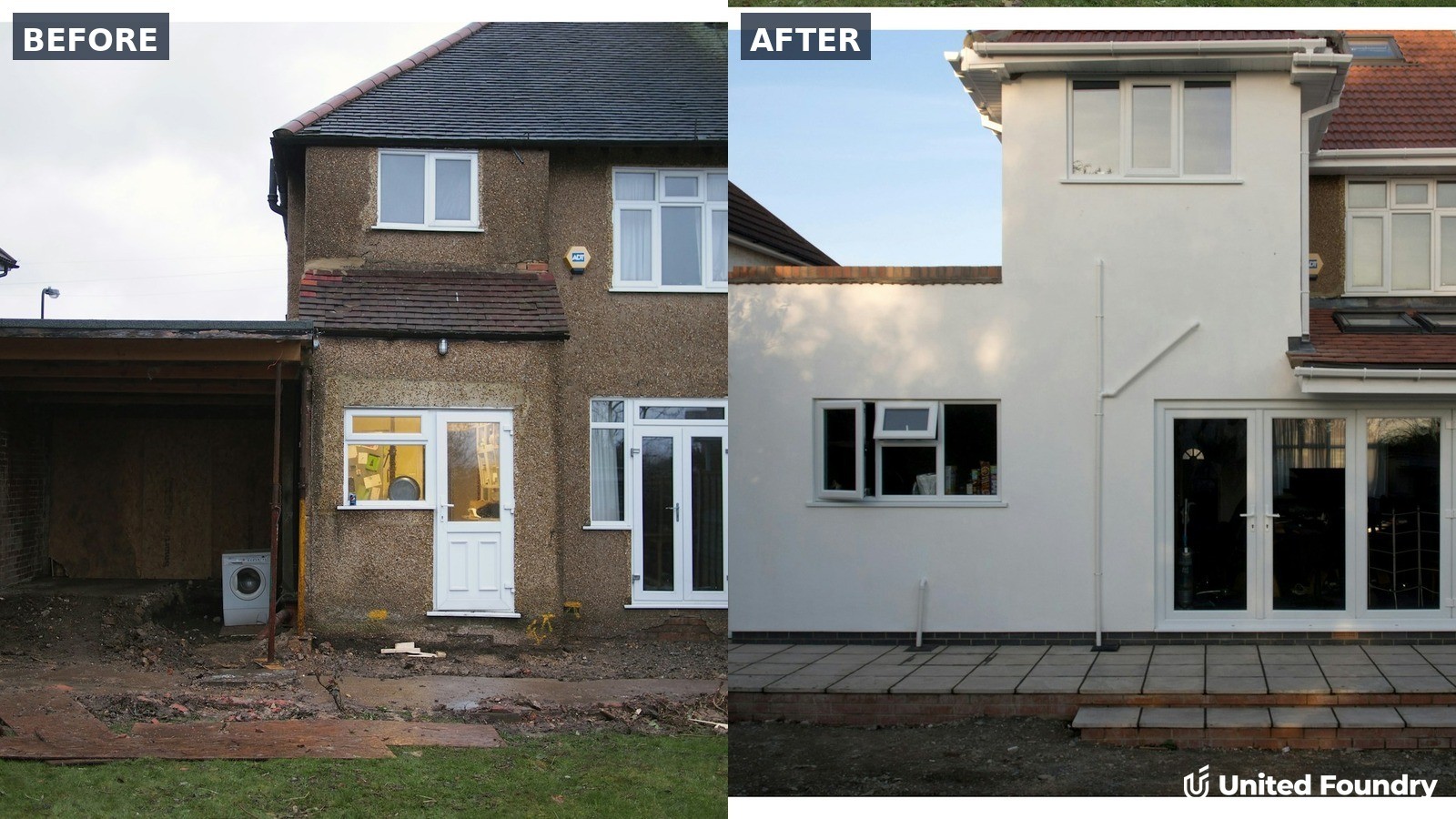
- Before-and-after photos, side by side. Not a gallery of twelve "after" shots. One clear before, one clear after, same angle if you can manage it.
- A direct quote from the homeowner. Pulled from a text, an email, or a review — not written by you. Real wording, even if it's a little rough, reads as more credible than a polished testimonial.
Three to five of these, built for your most common job types, outperform fifty generic photos. A roofer doesn't need twenty roof case studies — they need three: one storm-damage replacement, one full tear-off, one insurance-claim job. Match the case study to the decision a homeowner is actually trying to make.
Numbers Beat Adjectives
This is the part most contractor sites get backwards. "Gorgeous," "stunning," and "top-quality" are the same three words every competitor uses, so homeowners have learned to ignore them. A number is specific, and specific is what builds trust with someone who has never met you.
Compare these two sentences:
"We transformed this outdated kitchen into a stunning modern space the homeowners love."
"This 1987 kitchen had one working outlet and no counter space. We relocated two walls, added a 9-foot island, and finished the project in 9 weeks for $41,500."
The second sentence is the one that gets read to the end. It's also the one that pre-qualifies the lead — a homeowner with a $15,000 budget self-selects out before they ever pick up the phone, which means fewer tire-kicker estimate calls and more time quoting jobs you'll actually win.
This same math-forward thinking is why putting price ranges on your website works — homeowners want the number before they'll commit to a call, and a case study is the most natural place to give it to them in context.
Where the Page Lives — and How Fast It Needs to Load
A case study page only does its job if a homeowner actually reaches it. That means it needs a clear link from your homepage, not three clicks deep in a dropdown menu — the same logic behind what belongs above the fold on a contractor homepage.
It also needs to load fast. Case study pages are usually the most image-heavy pages on the entire site — multiple before-and-after photos, sometimes at full resolution straight out of a phone camera. A slow-loading case study page is a contradiction: you're trying to prove you do careful, quality work, and the first thing the homeowner experiences is a 6-second spinner. Compress the images before they go up. The conversion math around site speed and lead conversion applies double here.
Turn the Proof Into a Booked Call
A case study page that ends with just a "Contact Us" link at the bottom is wasting the trust it just built. The homeowner is at their most convinced in the thirty seconds after reading a case study that matches their situation — that's the moment to ask for the next step, not three scrolls later. Pair the page with a short, low-friction way to act, the same thinking behind choosing the right form fields for your estimate request.
The cleanest version of that next step is a free discovery call — a specific, named action that feels lower-commitment than "request an estimate," even though it leads to the same place.
Three to five sharp case studies, structured the same way every time, with real numbers instead of adjectives: that's a page that sells while you're on a job site, asleep, or quoting someone else entirely. It's one of the cheapest upgrades a builder or remodeler can make to a site that's already live — no redesign required, just better proof, structured better.
If your site doesn't have this yet, or your "Our Work" page is still just an unlabeled photo gallery, a discovery call is the fastest way to find out what's costing you the most estimate calls right now.